


Karnak Temple
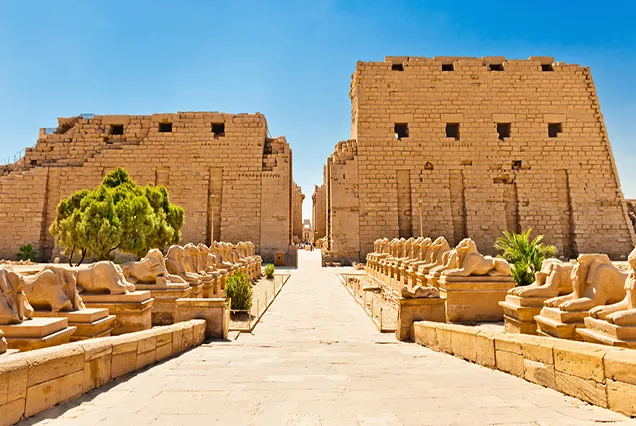
The Magnificent Karnak Temple Complex: A Comprehensive Guide to Egypt's Greatest Open-Air Museum!
The Living Testament of Ancient Thebes
Spanning over 200 hectares (494 acres) along the east bank of the Nile near modern Luxor, the Karnak Temple Complex stands as the largest religious site ever constructed. Unlike the static pyramids of Giza, Karnak evolved organically over 2,000 years of continuous development—from the Middle Kingdom (c. 2000–1700 BCE) through the Ptolemaic era (305–30 BCE). This UNESCO World Heritage Site represents the architectural embodiment of ancient Egypt's theological, political, and artistic journey, where each pharaoh left his mark in stone to honor Amun-Re, the "King of Gods."
.webp?1755205197782)
Etymology and Historical Significance
Original Name: Ipet-Isut ("The Most Select of Places")
The complex's ancient Egyptian name reflects its status as the spiritual heart of Theban worship. Modern nomenclature derives from Al-Karnak ("fortified village"), referencing the Arab-era settlement amidst the ruins.
Chronological Development
- Middle Kingdom (c. 1971–1926 BCE): Senusret I establishes the first Amun temple core
- New Kingdom (1550–1070 BCE): Golden age under Thutmose III, Hatshepsut, Seti I, and Ramses II
- Late Period (664–332 BCE): Nubian and Persian additions
- Ptolemaic Era (305–30 BCE): Final major constructions before decline
Architectural Marvels: A Sector-by-Sector Breakdown
1. Precinct of Amun-Re (Main Complex)
Key Features:
- Great Hypostyle Hall: 5,000 m² forest of 134 columns (12 central columns soar to 21m)
- Obelisks of Hatshepsut: 29m red granite monoliths (still the world's second-tallest standing obelisks)
- Sacred Lake: 120m x 77m ritual purification basin
- First Pylon: Unfinished 113m-wide gateway built by Nectanebo I
Engineering Insights:
- Sandstone quarried from Gebel Silsila (161km south) transported via Nile barges
- Obelisks erected using inclined mudbrick ramps (evidence from unfinished Aswan obelisk)
- Astronomical alignment: Winter solstice sunlight penetrates to Amun's inner sanctuary
2. Precinct of Mut (Southern Complex)
Dedicated to: The mother goddess Mut, consort of Amun
Notable Elements:
- Crescent-shaped sacred lake (symbolic of primordial waters)
- 600+ black granite statues of Sekhmet discovered in 1976
- "Porch of Drunkenness": Hatshepsut's festival site for the Sekhmet ritual involving ritualized intoxication
3. Precinct of Montu (Northern Complex)
- Dedicated to: The warrior god Montu, son of Amun and Mut
- Current Status: Largely unexcavated; closed to public
4. Temple of Amenhotep IV (Destroyed)
Historical Paradox: Akhenaten's sun temple built before his Amarna heresy was systematically dismantled after his death. Recent radar surveys suggest undiscovered foundations east of Amun-Re precinct.
.webp?1755205227581)
Construction Techniques: How Karnak Was Built
Column Construction
- Drum stacking: Limestone segments hoisted via levers and counterweights
- "Finish in place" method: Final carving done after erection (see unfinished column in northwest sector)
Obelisk Transportation
- Quarried from Aswan granite
- Transported on sledges during Nile floods
- Raised via gradual ramp removal (demonstrated by Japanese team in 1999)
Acoustical Engineering
Recent studies show the Hypostyle Hall's column spacing creates resonant frequencies that amplify ritual chants.
Historical Timeline: Karnak Through the Ages
Middle Kingdom Foundations
- Senusret I's White Chapel: Dismantled but reconstructed in Open-Air Museum
New Kingdom Zenith
- Hatshepsut: 4 obelisks and Red Chapel (barque shrine)
- Thutmose III: Festival Hall with unique tentpole-inspired columns
- Seti I & Ramses II: Hypostyle Hall reliefs depicting Battle of Kadesh
Late Period Adaptations
-
Nubian Pharaoh Taharqa: Built the tallest column (21m) now toppled
-
Persian Occupation: Darius I's inscribed gateway
Greco-Roman Transformations
- Ptolemy III's massive gateway
- Christian reuse: 4th century AD church in Thutmose III's festival hall
.webp?1755205261275)
European Rediscovery: From Medieval Myths to Modern Archaeology
Early Accounts
- 1589 Venetian manuscript: First European description (Biblioteca Nazionale, Florence)
- 1678 Capuchin monks: First use of "Karnak" in print
Scientific Documentation
- Napoleonic Expedition (1798): Detailed sketches by Vivant Denon
- 19th Century Epigraphers: Champollion and Rosellini's hieroglyphic recordings
Modern Excavations
- 1924–Present: Continuous work by French-Egyptian Center (CFEETK)
- 2016 3D Mapping Project: Digital reconstruction of construction sequence
Must-See Features for Visitors
Top 5 Highlights
- Hypostyle Hall: Experience the forest of columns at dawn
- Hatshepsut's Obelisk: Admire the remaining 29m monolith
- Sacred Lake: Imagine ancient purification rituals
- Open-Air Museum: Reconstructed Middle Kingdom shrines
- Cachette Court: Where 17,000 statues were discovered in 1903
Hidden Gems
- Thutmose III's Botanical Garden: Unique carvings of foreign plants
- Ramses II's Battle Scenes: Earliest known depiction of siege ladders
- Ptolemaic gateways: Blend of Egyptian and Hellenistic styles
Visitor Information (2025 Update)
Practical Details
- Hours: 6:00 AM – 5:30 PM (winter); 6:00 AM – 6:00 PM (summer)
- Tickets: 200 EGP (adult); 100 EGP (student)
- Guided Tours: Essential for context (recommended: Egypt Tailor Made)
Optimal Visiting Strategy
- Early Morning: Beat crowds and heat (arrive by 7 AM)
- Route: Start at Hypostyle Hall → Obelisks → Sacred Lake → Open-Air Museum
- Photography Tip: Long lenses for column details; wide-angle for Hypostyle
.webp?1755205293871)
Ongoing Mysteries and Recent Discoveries
Unsolved Questions
- The Lost Labyrinth: Herodotus' description of a vast underground complex
- Akhenaten's Missing Temple: Potential undiscovered structures
- Original Middle Kingdom Layout: Only 30% excavated
21st Century Breakthroughs
- 2011: Radar detection of unknown chambers near Sacred Lake
- 2020: Reconstruction of Senusret I's original altar
- 2023: AI analysis reveals hidden construction marks
Karnak Temple Light Show
The Karnak Sound and Light Show is a mesmerizing nighttime experience that brings the temple’s history to life through dramatic illuminations, music, and narration. As you walk through the illuminated complex, voices of pharaohs and gods recount tales of ancient Thebes, while projections highlight the temple’s grand columns and obelisks. The show runs twice nightly (in multiple languages) and offers a unique perspective on Karnak’s grandeur.
Karnak Temple Map
A detailed Karnak Temple map helps visitors navigate the vast complex, which includes the Precinct of Amun-Re, the Precinct of Mut, and the Precinct of Montu. Key landmarks marked on maps include the Great Hypostyle Hall, Sacred Lake, Hatshepsut’s Obelisk, and the Avenue of Sphinxes. Free maps are available at the entrance, but guided tours provide deeper insights into each section.
Karnak Temple Facts
- Largest religious complex ever built, covering 200+ acres with structures from 30+ pharaohs.
- The Great Hypostyle Hall contains 134 columns, the tallest reaching 21 meters (69 feet).
- Hatshepsut’s Obelisk (29m tall) remains the second-largest standing obelisk in Egypt.
- The Sacred Lake was used for ritual purification ceremonies by ancient priests.
Karnak Temple History
Construction began in the Middle Kingdom (c. 2000–1700 BCE) under Senusret I and continued for 2,000 years, with major expansions by Hatshepsut, Thutmose III, Seti I, and Ramses II. It served as the religious heart of Thebes, dedicated to the god Amun-Re. Later, Ptolemaic rulers and early Christians repurposed parts of the temple before it fell into ruins.
Karnak Temple Inside
Inside Karnak, visitors can explore:
- The Great Hypostyle Hall – A forest of towering columns covered in hieroglyphs.
- The Sacred Lake – Where priests performed purification rituals.
- Hatshepsut’s Obelisk – One of Egypt’s finest surviving monoliths.
- The Open-Air Museum – Houses reconstructed chapels, including the White Chapel of Senusret I.
Karnak Temple Photos
Photography is allowed (except in restricted areas), making Karnak a paradise for photographers. The best shots include:
- Sunrise/sunset lighting the Hypostyle Hall.
- Close-ups of hieroglyphs on columns and walls.
- The Sacred Lake’s reflections at golden hour.
- Wide-angle views of the massive pylons and obelisks.
Karnak Temple Architecture
Karnak’s architecture showcases ancient engineering genius:
- Columns: Designed with papyrus and lotus motifs, some weighing 70+ tons.
- Obelisks: Carved from Aswan granite and transported via the Nile.
- Astronomical Alignments: The temple is positioned for solstice sunrises.
- Construction Techniques: Used ramps, levers, and precise stone-cutting methods.
Karnak as Cultural Microcosm
More than just temple ruins, Karnak represents the cumulative genius of ancient Egyptian civilization—where theology inspired architectural innovation, political power manifested in stone, and artistic expression reached unparalleled heights. As ongoing excavations continue to rewrite history, the complex remains both an open history book and an active archaeological laboratory.
For those privileged to walk its processional ways, Karnak offers not just a glimpse into the past, but a direct connection to the minds of the ancients who believed their monuments would endure "for eternity and infinity." In this, they succeeded beyond their wildest dreams.
.webp?1755205317957)
Karnak Temple FAQs
Why is the temple at Karnak so famous?
Karnak is famous for being the largest ancient religious complex ever built, constructed over 2,000 years by multiple pharaohs. Its Great Hypostyle Hall, towering obelisks, and intricate hieroglyphs make it an architectural marvel.
Is Karnak the largest temple in the world?
Yes, Karnak is the largest religious complex globally, covering around 200 hectares. It dwarfs even Angkor Wat in sheer size and historical depth.
Is Luxor Temple the same as Karnak Temple?
No, Luxor Temple is a separate site 2.5 km south of Karnak, though both were connected by the Avenue of Sphinxes. Karnak is far larger and older.
Who is the god of the Karnak Temple?
The primary deity was Amun-Re, king of the gods in the Theban Triad. Later additions honored Mut (his consort) and Montu (their warrior son).
What are two facts about Karnak?
- It took 30+ pharaohs to build, including Ramses II and Hatshepsut.
- The Hypostyle Hall has 134 columns, some 21 meters (69 ft) tall.
Is Karnak Temple worth it?
Absolutely—its scale, artistry, and historical significance make it a top global landmark. Many consider it Egypt’s most impressive site after the pyramids.
Which is better, Karnak or Luxor?
- Karnak is more expansive and awe-inspiring, while Luxor Temple is more intact and accessible. Ideally, visit both—they’re linked by the ancient sphinx avenue.
What is the meaning of Karnak?
The name derives from Arabic Al-Karnak ("fortified village"), but its original name was Ipet-Isut ("The Most Select of Places").
What are the key highlights of the Karnak Temple?
Top sights: the Great Hypostyle Hall, Hatshepsut’s Obelisk, Sacred Lake, and Open-Air Museum with reconstructed shrines.
How much time do you need at Karnak Temple?
Plan 2–3 hours minimum. Half a day allows deeper exploration, especially with a guide to explain details.
Who built Karnak in Egypt?
Construction began under Senusret I (1971–1926 BCE), with major additions by Hatshepsut, Thutmose III, Seti I, and Ramses II.
How much is entry to Karnak Temple?
As of 2024: 200 EGP (~$6.50) for adults, 100 EGP (~$3.25) for students. Extra fees apply for sound-and-light shows.
How to Visit Karnak Temple
- Location: Luxor’s east bank, 2.5 km north of Luxor Temple.
- Hours: 6 AM–5:30 PM (winter), 6 AM–6 PM (summer).
- Tips: Visit early morning to avoid crowds, hire a guide for historical insights, and wear comfortable shoes for extensive walking.
Conclusion: Step into the Grandeur of Karnak Temple
The Karnak Temple Complex is more than just an archaeological wonder—it’s a journey through time, where the legacy of pharaohs, gods, and ancient engineers comes to life. From the towering columns of the Great Hypostyle Hall to the tranquil waters of the Sacred Lake, every corner of Karnak tells a story of devotion, power, and artistic brilliance. Whether you’re a history enthusiast, a photography lover, or simply seeking awe-inspiring experiences, Karnak is a must-visit destination that leaves every traveler spellbound.
.webp?1755205340557)
Ready to explore Karnak Temple for yourself?
At Nile cruises Tours agency, we offer expertly guided tours that bring the temple’s mysteries to life. Discover our specially curated Karnak Temple excursions by visiting our dedicated page: Explore Karnak Temple Tours Nile cruises Tours.
For instant booking assistance, feel free to message us on WhatsApp at +201040000210. Let us help you walk in the footsteps of pharaohs and experience the magic of Karnak firsthand!
Unlock ancient wonders, your adventure starts here!
Post Comment